When founders ask what is an MVP in software, they usually mean a working web or mobile application that does one job convincingly. In software, an MVP is a deployed, usable system — real database, real auth, real core workflow — that excludes everything not essential to the central value proposition.
Concretely, a software MVP almost always includes:
- One core workflow done well — the single thing your product exists to do, end to end.
- Real data persistence — users can create something, leave, come back, and it is still there.
- Authentication — even if it is just email-and-password or a magic link.
- A way to observe usage — basic analytics or event logging so you can actually learn.
And it almost always excludes, at first:
- Admin dashboards, granular permissions, and team-management features.
- Billing integrations, unless charging is the assumption you are testing.
- Settings pages, dark mode, onboarding tours, and the long tail of polish.
- Native apps when a responsive web app would answer the same question.
The discipline is ruthless scoping. Every feature you add before launch is a feature you are betting on without evidence.
A minimum viable product matters because runway is finite and certainty is expensive. The point of an MVP is to convert the largest unknown in your business into a known fact for the smallest possible cost. Founders who skip this step routinely spend six figures and a year building a product that solves a problem the market did not actually have.
Three things change the moment you ship an MVP instead of a full build.
- You replace opinion with evidence. Internal debates about features get settled by user behavior, not by whoever argues loudest.
- You shorten the distance to revenue. A live product can take payment, even from a handful of early customers, while a planned product earns nothing.
- You learn what to cut. Almost every MVP reveals that half the "essential" roadmap was never essential. That insight alone often saves more than the build cost.
In our experience the founders who win are not the ones with the most complete spec. They are the ones who get a real product into real hands fastest and then iterate against what they observe.
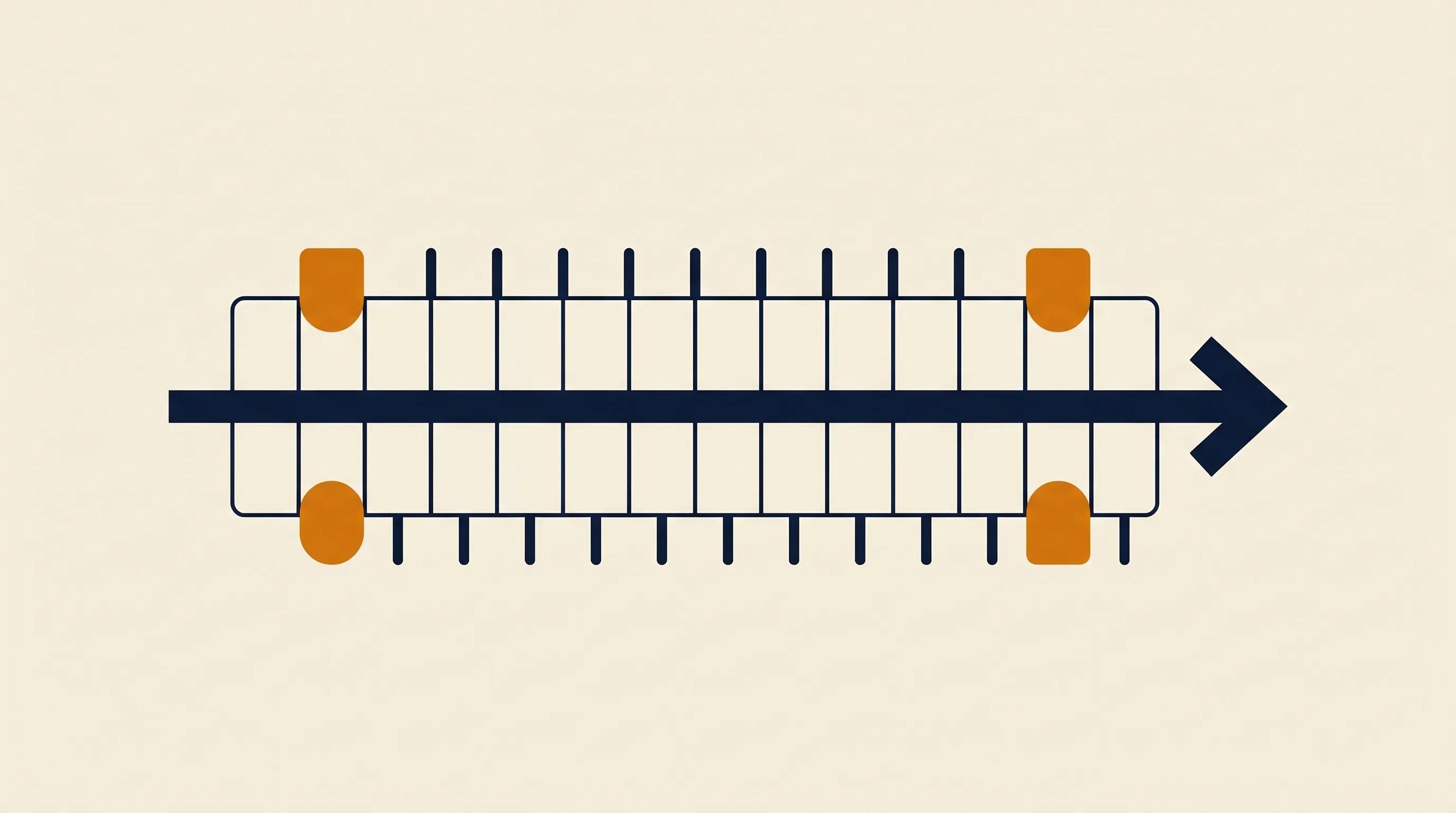
The MVP is a loop, not a milestone. It runs in four repeating stages, and the speed of that loop matters more than the size of any single release.
Every idea rests on assumptions. People will pay for this. They will switch from their current tool. They will trust us with their data. Rank them by danger. The MVP exists to test the one that, if false, kills the whole business. Build for that, and nothing else.
Translate the assumption into the smallest feature set that can test it honestly. If the assumption is "freelancers will pay to automate invoicing," you need invoice creation and a payment path — not a full accounting suite.
Deploy it to real users and watch. Activation rate, repeat usage, drop-off points, and direct feedback are the signals. A pretty product with no instrumentation teaches you nothing.
The data tells you to double down, change direction, or stop. This is the only stage that produces a return on the build. Skipping it turns an MVP back into an ordinary expensive launch.
For a deeper walkthrough of the build mechanics, our guide on how to build an MVP step by step breaks each stage into concrete tasks.
The most-cited examples are famous because they look almost embarrassingly small in hindsight.
- Dropbox launched with a three-minute explainer video instead of working sync software. The waitlist exploded overnight, validating demand before a single byte was synced. That was an MVP — the assumption being tested was "do people want this," not "can we build it."
- Airbnb began as a single page renting three air mattresses in the founders' apartment during a conference. No payments platform, no reviews, no maps. Just a test of whether strangers would pay to sleep on a floor.
- Zappos started by photographing shoes in local stores and listing them online; when an order came in, a founder bought the pair at retail and shipped it. The assumption: would people buy shoes online at all.
Each example tested one assumption with the least possible engineering. Notice none of them built the full product first. For software founders specifically, the patterns we see most often are covered in our SaaS MVP development guide, which maps these principles onto recurring-revenue products.
People use MVP and prototype interchangeably, and the confusion costs real money. They are different tools for different stages.
A prototype is a model used to test a design or interaction — often clickable mockups in Figma. It is not real software, has no backend, and cannot be used to do actual work. Its job is to validate how something should look and feel with internal stakeholders or a few users.
An MVP is functional software in production that real users adopt to get a real outcome. Its job is to validate whether the market wants the thing at all, measured by behavior and ideally revenue.
The short version: a prototype answers "does this design make sense?" An MVP answers "will people use and pay for this?" You often build a prototype before an MVP, but a prototype is never a substitute for one.
A proof of concept (PoC) and a minimum viable product sit at opposite ends of the validation spectrum, and conflating them leads to scope chaos.
A proof of concept answers a technical question: can this even be built? It is usually internal, throwaway code that proves a hard integration, an algorithm, or a performance threshold is achievable. Nobody outside the team ever sees it.
An MVP answers a market question: do customers want this enough to use it? It is shipped, supported, and built to last because real users depend on it.
You might build a PoC to prove a tricky AI feature is feasible, then build a separate MVP to prove customers care. They are sequential, not synonymous. Treating a PoC as if it were your MVP is how teams end up shipping fragile internal code to paying customers.
Deciding what to leave out is harder than deciding what to put in, because every excluded feature feels like a risk. A simple filter helps: for each feature, ask whether it directly tests the riskiest assumption. If the answer is no, it waits.
Common features that almost always belong in version two, not the MVP:
- Granular roles and permissions. Early users are forgiving; build org-level access later.
- Multiple integrations. Pick the one your first customers cannot live without.
- Internationalization, white-labeling, and theming. Pure scope inflation pre-validation.
- Edge-case handling for users you do not have yet. Solve for the user in front of you.
- Self-serve onboarding flows. Onboard your first ten users by hand — you will learn more.
The willingness to ship something visibly incomplete is what separates founders who validate fast from those who polish their way out of the market.
A real software MVP should take weeks, not quarters. If your build plan runs past three months, the scope is almost certainly too large to be "minimum." Long timelines are a symptom of unisolated assumptions — you are building several experiments at once instead of the one that matters.
This is why our own delivery model exists: TaskifyLabs ships production MVPs in the $2,000–$5,000 range, typically inside a 14-day window, by enforcing exactly the scoping discipline described above. The constraint is the feature. A tight timeline forces the brutal prioritization that produces a genuinely minimum viable product instead of a bloated near-launch that never ships.
When you do start comparing build partners, our breakdown of the best MVP development companies covers what to look for. If you would rather understand the budget side first, the MVP development cost guide walks through where the money actually goes. And if you want a partner to scope and build it with you, our MVP development service starts with a short scoping call.
The same handful of errors sink most first attempts, and all of them stem from misreading one of the two words in the name.
- Mistaking "minimum" for "low quality." Minimum means fewer features, not broken ones. The features you do ship must work flawlessly.
- Building for imaginary scale. Optimizing infrastructure for a million users you do not have wastes the exact time you needed to find your first ten.
- Skipping instrumentation. Launching without analytics means you ship, learn nothing, and guess again. The learning is the entire point.
- Refusing to launch until it is "ready." It will never feel ready. Shipped and measured beats perfect and theoretical, every time.
- Testing five assumptions at once. A bloated MVP cannot tell you which assumption was right or wrong. Isolate one.
Avoid these and the MVP does its job: it tells you the truth about your idea before you have spent everything proving it.
If this guide answered the "what" and you are ready for the "how," these are the logical next steps:
An MVP is ultimately a mindset before it is a piece of software. It refuses to assume the market wants what a founder imagines; it builds the smallest honest test and lets real users decide. The founders who internalize that — who treat the first release as a question rather than an answer — are the ones who stop burning runway on guesses and start building products people genuinely use. Define your riskiest assumption, scope to the thinnest slice that tests it, ship it, and let the evidence tell you what to build next.