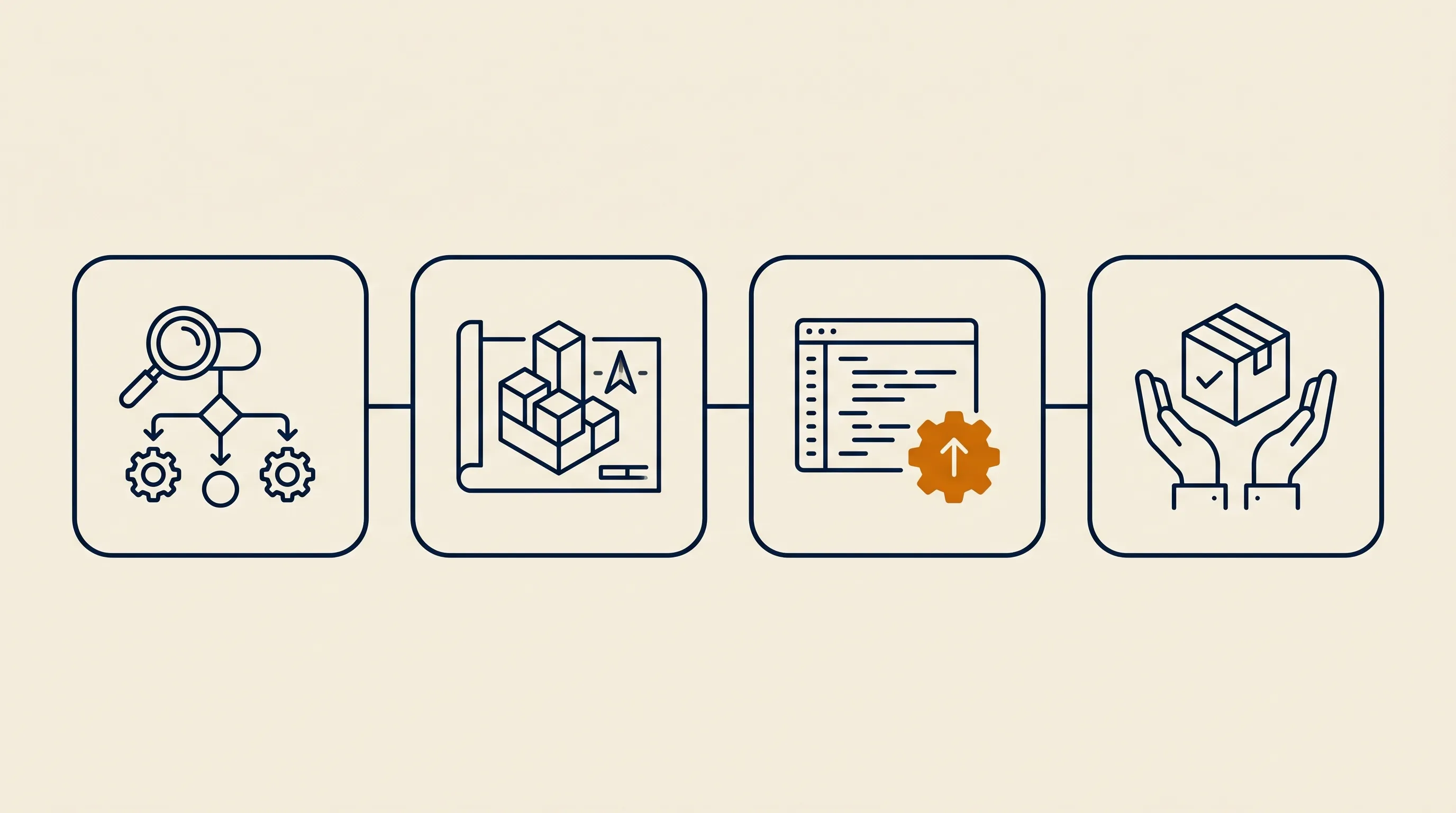
Days 1 through 3 are the architecture phase of the MVP development process. The senior engineer who will write your code spends three days turning the scope into an executable plan. This is the most under-documented phase in most agency processes because it doesn't bill well as a separate deliverable — but skipping it is why hourly MVPs run over.
<strong>The Day 1–3 deliverables</strong> are:
- A data model. Postgres schema, relationships, indexes, and migration strategy written out before the first table is created.
- The API surface. Every route, every payload shape, every auth requirement decided upfront. No discovering endpoints mid-sprint.
- The auth flow. Email + at least one social provider (Google or Apple), session strategy, and any role logic.
- The LLM/agent design. If the MVP has AI features, the prompt structure, retrieval strategy, and grounding sources get specified here — not improvised in week two.
- A day-by-day sprint board. You get a written board with each of Days 4 through 12 mapped to specific deliverables. You can track build progress against it daily.
By end of Day 3 you have a written architecture doc and a sprint board. Day 4 starts the build with zero "let's figure that out when we get there" left in the project.
Days 4 through 12 are the build sprint — nine working days of senior-engineer-only development. <strong>The MVP build process is daily-deployed</strong>, which is the single biggest difference between productized and hourly MVP development.
What happens each day:
- Daily commits to a private staging environment you can log into and click through.
- One async mid-sprint checkpoint around Day 7 or 8 where we share what's working, what's left, and any decisions that need your input.
- One round of revisions baked into the sprint. Use it for adjustments — copy, flow changes, small scope clarifications. Out-of-scope additions get banked for a v1.1 sprint after launch.
- No daily standups, no scrum ceremonies, no Slack chatter that pretends to be progress. The progress is the code, and you can see it on staging every morning.
The senior engineer on the build is the same person who was on your Day 0 scoping call. There is no junior outsourcing, no offshore handoff, no broken telephone between a salesperson and the team writing the code. <strong>The build sprint is the same person from Day 0 through Day 14</strong>.
If you want to see this process at the service level, the MVP Development services page shows the same Day 0 / Day 1–3 / Day 4–12 / Day 13–14 structure with case studies attached.
The last two days of the MVP development process are the production deploy and handoff. The build is feature-complete by end of Day 12. Days 13 and 14 turn it into a production system you own.
The Day 13–14 deliverables are:
- Production domain + SSL. Your domain, configured DNS, working SSL certificate, environment variables set on the production environment.
- Monitoring. Error tracking (Sentry or equivalent) and basic uptime monitoring configured.
- A walkthrough video. A 30-minute screen recording walking through every feature, the codebase structure, where to make common changes, and how the AI features are wired up.
- Full repository handoff. Every line of code transferred to your GitHub organization. We do not retain any IP. You own everything.
- A written architecture doc. The same one written on Days 1–3, updated to reflect what shipped. Any future developer can pick up the code with the doc + walkthrough video alone.
- Optional retainer. If you want the same team to keep building, we have a clear monthly retainer rate. If not, walk away with the code — no pressure.
By end of Day 14 you have live software, a private repo you own, a video that documents it, and a contact for the engineer who built it. That is the entire MVP delivery process for a standard-scope build.
Phase — Days / What we do / What you get
- Scoping — Days: Day 0 — What we do: 20-minute call, lock scope + stack + price — What you get: Written fixed-price scope
- Architecture — Days: Days 1–3 — What we do: Data model, API surface, auth, LLM design, sprint board — What you get: Architecture doc + day-by-day plan
- Build sprint — Days: Days 4–12 — What we do: Senior-engineer-only build, daily commits to staging — What you get: Daily-deployed working software
- Mid-sprint checkpoint — Days: Day 7–8 — What we do: Async progress + decision points — What you get: One round of in-scope revisions
- Handoff — Days: Days 13–14 — What we do: Production deploy, walkthrough, repo transfer — What you get: Live MVP + full IP + walkthrough video
Two weeks. Four phases. Each phase has a deliverable you can point at. That is what makes the MVP build process auditable — you are never wondering what week three of "discovery" was supposed to produce.
Most boutique agencies run a six-phase process: discovery, design, planning, development, QA, deployment. Each phase has a separate deliverable, a separate timeline, and usually a separate invoice. The cost grows because the process is the product — they bill for the process, not the software.
The productized MVP development process collapses discovery, design, and planning into Days 0–3, writes tests inside the build sprint instead of a separate QA phase, and makes deploy part of Days 13–14. The result is the same production-grade software in a fraction of the calendar time.
The trade-offs are real. The process needs scope discipline on Day 0, a senior engineer doing the work, and a founder available for one async mid-sprint checkpoint. For most pre-seed founders the trade-offs are worth it — the validation milestone is first paying customer or signed LOI, and a two-week sprint beats a three-month sprint to the same product every time.
Not every MVP fits the standard 14-day scope. The MVP software development process has two off-ramps:
- Custom engagement. If on the Day 0 call we determine the scope needs three to six weeks instead of two, we quote a Custom engagement from $7,500. Same four-phase process, longer build sprint, same senior-engineer-only model. We agree the timeline upfront before any contract.
- Phased delivery. Some projects fit a "ship a real 14-day MVP, then sprint a v1.1 in another 14 days" model better than one long build. This works especially well for SaaS MVPs where founders want a paying-customer-ready product fast, then add multi-tenant or billing features in sprint two. The SaaS MVP and Startup MVP pages have specific scope examples.
What never happens: a 14-day MVP that quietly stretches into eight weeks. The phase structure makes drift visible by Day 5. If a project is not on track, we say so — and we have not yet had a standard-scope project miss its 14-day deadline.
The MVP development process is fast because the founder side is light. Before the scoping call, founders should have:
- A one-line description of the product. "An AI tool that does X for Y users so they can Z." If you cannot say it in one sentence, the scope is not yet ready.
- A short list of must-have features. Five to ten things the MVP needs to do. Anything more becomes v1.1.
- A validation milestone. What does success look like? First paying customer? First LOI? First 100 signups? The milestone defines the scope.
- Domain and provider preferences (optional). If you already have a domain, a cloud account, or strong stack preferences, bring them. If not, we use sensible defaults.
You do not need wireframes. You do not need a spec document. You do not need a discovery phase to identify your users. The Day 0 call surfaces all of that in 20 minutes if the founder has done the validation thinking. If they have not, the right next step is more market work, not more agency work.
Custom AI features are part of standard scope, not premium add-ons. <strong>The AI portion of the MVP development process is wired in from Day 1</strong>, not bolted on at the end:
- Day 0: AI use case locked. Specific provider, specific feature, specific data source — "OpenAI to summarize call transcripts" or "Claude with RAG over your product docs".
- Days 1–3: Prompt structure, retrieval strategy, and grounding sources designed alongside the schema.
- Days 4–12: AI features built and tested with real data from your domain — prompts iterated against actual outputs, not toy inputs.
- Days 13–14: Token-cost monitoring and rate-limiting deployed with the rest of the production setup.
A common failure mode in less-experienced MVP processes is treating AI as a "polish phase" feature added in week 12. By then the schema is wrong and the prompt is fighting the architecture. The productized process bakes AI into the architecture phase so the rest of the build supports it.
Three disciplines keep the MVP delivery process on rails:
Lock scope in writing on Day 0. No verbal scope, no "we will figure that out", no Slack scope. The written, signed scope from Day 0 is the cheapest scope-creep prevention tool in the engagement. Every change request after Day 0 gets evaluated against the scope and either banked for v1.1 or quoted separately.
Make progress visible daily. The daily-deployed staging environment means there is no "trust me, it is going well" between Day 4 and Day 12. You can see the actual software every morning. Drift gets caught on Day 5, not on Day 14.
One senior engineer end-to-end. Multi-engineer MVP teams have a coordination tax that consumes most of the speed advantage of a tight sprint. The productized model assigns one senior engineer from scoping to handoff, with on-call backup for emergencies but no day-to-day handoff between people. This is the largest single difference between TaskifyLabs's process and an agency process — and the reason a 14-day timeline is achievable without cutting quality.
For a deeper look at the speed model, rapid MVP development in 14 days covers the engineering decisions that make this process viable. For pricing context, MVP development cost breaks down why the productized process costs $3K–$5K instead of $25K–$50K.